


Please Consider Donating us
We are helping millions of Beginners and Professionals to learn new programming technologies.
Please consider donating us:



jQuery AJAX Example – Calling a C# Function With jQuery AJAX [With Code]
![jQuery AJAX Example – Calling a C# Function With jQuery AJAX [With Code]](https://www.yogihosting.com/wp-content/uploads/2014/12/jquery-ajax.png "jQuery AJAX Example – Calling a C# Function With jQuery AJAX [With Code]")
In this jQuery AJAX Example, you’ll learn about one of jQuery’s most powerful features — performing an Asynchronous HTTP Request, commonly known as AJAX (Asynchronous JavaScript and XML). With AJAX, you can update specific sections of your web page without reloading it entirely, making your application faster, more lightweight, and significantly more interactive.
In this tutorial, I’ll walk you through creating a simple yet powerful jQuery AJAX example that demonstrates how easily it can be implemented in your web application. Along the way, I’ll also cover jQuery Validation techniques to prevent users from entering invalid values into the text boxes.
I will create this application in ASP.NET Web Forms with C# as the programming language. I will be making AJAX call using jQuery AJAX method.

Now coming to the development part, here I have two text boxes, one for name and other for email, and a submit button.
When the user fills in both text boxes and clicks the button, an AJAX request is sent to the C# function on the server — all without triggering a page postback.
The work of this C# function is to store the two text boxes information in the database.
At the end, the function returns the success or failed message, depending up on whether the information is saved successfully in the database or not.
The HTML of the Web Page and jQuery AJAX Method is given below:
Page HTML
<h1>Subscribe To Our Newsletter</h1>
<div id="errorDiv"></div>
<table>
    <tr>
        <td>Name:-</td>
        <td>
            <input type="text" id="nameInput"/></td>
    </tr>
    <tr>
        <td>Email:-</td>
        <td>
            <input type="text" id="emailInput" /></td>
    </tr>
    <tr>
        <td colspan="2">
            <input type="submit" id="submitButton" value="Submit"/></td>
    </tr>
</table>
<img src="Image/loading.gif" id="loadingImg" hidden="hidden"/>
The jQuery AJAX Method Calls the Below C# Function
[WebMethod]
public static string Subscribe(string name, string email)
{
    //Insert it to our database
    return "thanks "+name+", your email "+email+" is subscribed to our newsletter.";
}
It is an attribute that can be applied to certain functions in C#. It is necessary that this method should be static and must have the attribute of [WebMethod] so that it can be called with the jQuery AJAX Method.
jQuery AJAX Method Code
$(document).ready(function () {
    $("#submitButton").click(function (e) {
        var result = ValidateAll();
        if (result == true) {
            $.ajax({
                type: "POST",
                url: "jquery-ajax.aspx/Subscribe",
                contentType: "application/json; charset=utf-8",
                data: '{"name":"' + $("#nameInput").val() + '","email":"' + $("#emailInput").val() + '"}',
                dataType: "json",
                success: function (msg) {
                    if (msg.d) {
                        $("#errorDiv").html(msg.d);
                    }
                },
                error: function (req, status, error) {
                    alert("Error try again");
                }
            });
        }
        return false;
    });
});
- The jQuery AJAX method is called in the submit button click event.
- I have given the C# function’s location to the url field, and passed the values of the two text boxes in the function parameter by using the data field.
- Finally, the returned message (that is returned by the C# function), is shown on the errorDiv.

Please note that return false is added at the end of the button’s click event handler. This ensures that clicking the button does not trigger a page postback, keeping the entire interaction asynchronous.
You can use jQuery AJAX Events to display a loading image whenever an jQuery AJAX Call is made, and automatically hide it once the call completes.
For this we can use the ajaxStart and ajaxStop functions. The updated code is given below:
$(document).ready(function () {
    $(document).ajaxStart(function () {
        $("#loadingImg").show();
    });

    $(document).ajaxStop(function () {
        $("#loadingImg").hide();
    });

    //jQuery AJAX Method
});
Kindly check the below link for this tutorial:
The whole process is explained on the below image:
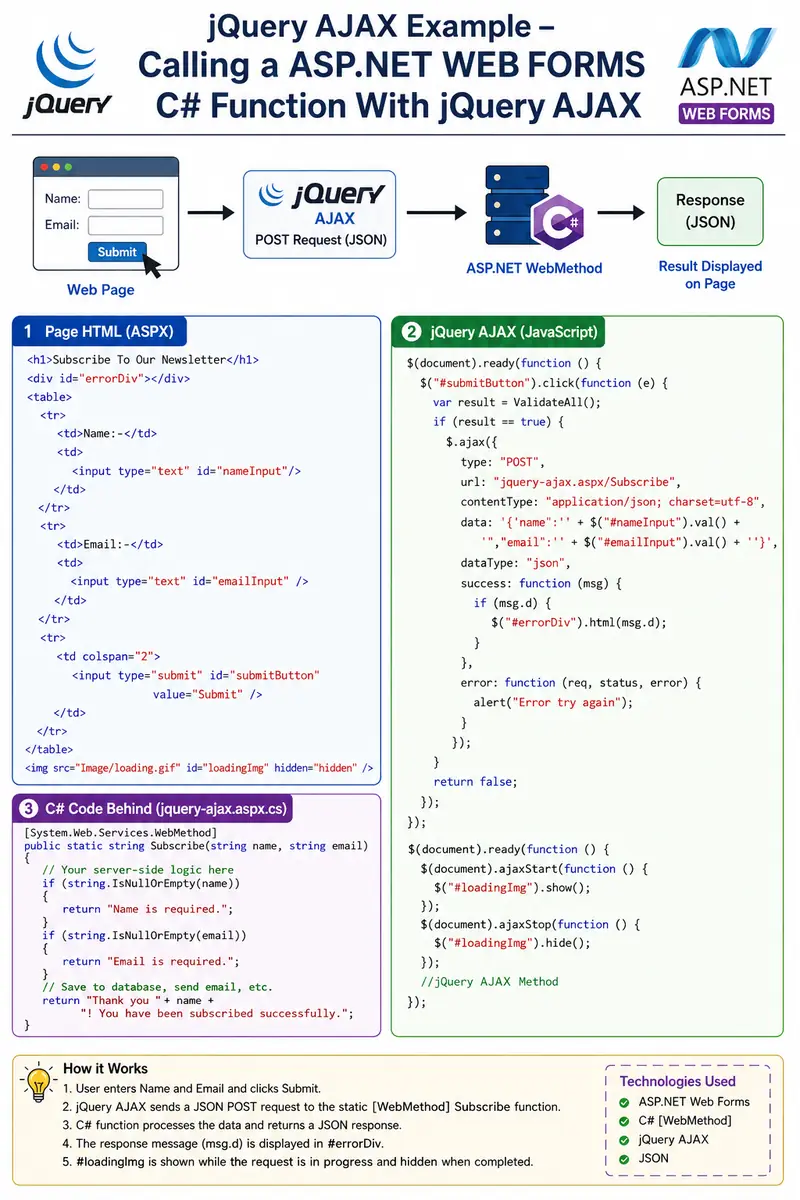
I hope you learned this jQuery AJAX Example and now can go on and use it in your websites. The jQuery AJAX is very useful for making complex looking things in a better manner.
With it, you will reduce your code’s length and will make your web application faster, manageable and lighter. The jQuery AJAX will also benefit your server by giving it less load, and so it is a win-win situation for both website administrators and their customers.
1. How to Make Sticky Ads with jQuery Effortlessly.
2. Creating jQuery Expand Collapse Panels In HTML.
SHARE THIS ARTICLE


Related Tutorials:




ABOUT THE AUTHOR
I hope you enjoyed reading this tutorial. If it helped you then consider buying a cup of coffee for me. This will help me in writing more such good tutorials for the readers. Thank you.

HELLO EVERYONE
 Welcome to YogiHosting - A Programming Tutorial Website. It is used by millions of people around the world to learn and explore about ASP.NET Core, Blazor, jQuery, JavaScript, Docker, Kubernetes and other topics.
SUBSCRIBE TO NEWSLETTER
Enter your email address to subscribe to this blog and receive notifications of new posts by email.
Join 90K other subscribers